Saturday, 8 December 2012

The Three Kings came from Andalusia states Pope Benedict XVI

Now Christmas time is arriving and in every village and in every house in Andalusia people will install as usual their belén, or nativity scene. Apart from Maria, Joseph and the baby Jesus, these scenes always go accompanied by the three kings, Baltazar, Melchor and Gazpar bringing their presents to Jesus: gold, mirre and incense.

Baltazar, Gaspar and Melchor in a typical nativity scene
It was thought that these kings came from the far east as many christmas carrols in Spain claim, but now Pope Benedict XVI has stated in his recently published book 'The Childhood of Jesus' that probably these kings came from the region known as Tartessos, believed to be located somewhere in the provinces of Cadiz, Seville and Huelva.

The kings come every year on the eve of th 5th of january at dusk to bring their presents. In some cities they even come on camels or donkeys, but nowadays most of them come on a motorised vehicle. They and their pages throw lots of sweets to all the children attending the parade.


That evening you have to put some anisette for the kings and some hay for the animals on the nativity scene and the shoes of the children, so that the kings can leave their presents there.
The sixth of january is a bank holiday and everybody sits down to enjoy the presents and the 'Roscon de Reyes' a special cake which contains an image of the king or the virgen Mary (which means luck for the coming year) and a bean (which means that you have to pay the 'Roscon' the next year).


Thursday, 22 November 2012

Typical products of Andalusia: Malaga wine


Remember the wines our grandmothers and great grandmothers drank, sipping of very small glasses, and only on very special occasions? This sweet very tasty wine (known as Malaga Dulce) is able to take away all your sorrow, as the famous 'Quitapenas' bodega claims.
Málaga wine began as a deep brown, rich, raisiny wine, created by the Greeks in 600 BC. It was originally called Xarabal Malaguii, "Málaga syrup", and was very sweet. It was created in the Andalucia region of Malaga - close to Cadiz, the region of Sherry.

In 44 AD, Columela wrote about the fine wines available in the Roman Province of Málaga. Its popularity grew. During the 1500s, something had to be done to wine to allow it to last the long ocean journeys. Brandy was added to allow the wine to last longer, and to be more resistant to temperature changes. This is why Málaga is termed a "fortified wine".  It was then one of the most expensive wines of Europe.

Spain now produces 5.8 million gallons of Málaga a year. Málaga is mostly made with the pedro ximinez grape,the wine must actually be aged in the city of Málaga to earn the name. Málaga is regulated by the Consejo Regulador.


The malaga wine is grown inland in all the province of Malaga (Axarquía, Antequera etc), and due to the extremes in temperature: hot and sunny summers and cold but sunny winters the grapes develop the character needed for a fine wine. The predominant variety here is the Pedro Ximenez, which is named after a 17th-century Spanish soldier thought to have introduced it from Germany. It has an exceptionally high sugar content, which is made even higher thanks to the process of letting the grapes roast in the sun before pressing, which reduces their moisture and concentrates the sugar. This partial raisining accounts for traditional Málaga wine's dark colour, for the Moscatel and Pedro Ximenez are both in fact white grapes.
If you want to know more about Malaga wines, remember to visit the Malaga wine museum.

More information about the Bodega Quitapenas: www.quitapenas.es, visits of this bodega are free. The bodega is located in Malaga.

Nice houses in the province of Malaga are:
Ecotourism la Cabra Verde
and in the Antequera region: Casa de la Torre, Casa la Ecina and Casa la Parada, all mentioned houses with their own private pool.  


Wednesday, 7 November 2012

Sierra de las Nieves natural park


The Sierra de las Nieves Natural Park is located at the heart of the natural Serrania de Ronda region, in the province of Malaga. This mountainous area is punctuated by deep ravines and spectacular cliffs, such as La Caína, with a drop of over 100 metres.
Furthermore, the limestone nature of the earth has created a number of potholes, such as the GESM, the world's third deepest at 1,100 metres
The Sierra de  las Nieves natural park is formed by parts of the municipalties of: Ronda, Monda, Tolox, El Burgo, Yunquera, Istán and Parauta

The highest peak is Torrecilla (1,919 metres) in the Sierra Blanca de Tolox.
Its greatest treasure are its conifer forests dating back to the tertiary period, featuring the Spanish fir (the "Pinsapo"), the most unusual species of fir in the world. 

Sierra de las Nieves natural park
Its relief is extremely rugged, with the deep ravines, high cliffs and gorges characteristic of Alpine folding.

Fauna: The area is home to one of Andalusia's largest communities of mountain goat, one of only two wild species of large hoofed mammal native to the Park, the other being the deer.
Other species such as the stag and mountain ox have been brought in, the Park providing them with an excellent habitat. Also to be found here are certain animal species protected by law, such as the wild cat, golden eagle and otter, the latter having practically disappeared from the River Verde.


Flora:
In the mountain peaks, where precipitation and fog are common, large numbers of gall oaks and Spanish firs are to be found.
At lower altitudes the holm oak and cork oak thrive. There are also small collections of madroños, chestnut trees, yews, maples and  ashes.

Points of Interest:
El Torrecilla, Sima GESM, Pinsapo de las Escaleretas, Mirador del Guarda Forestal, Tajo de la Caína. 

   Information source: www.andalucia.org. 

Le Chien Andalous offers here Ecotourism La Cabra Verde, with two nice houses with each their own private pool.

Wednesday, 24 October 2012

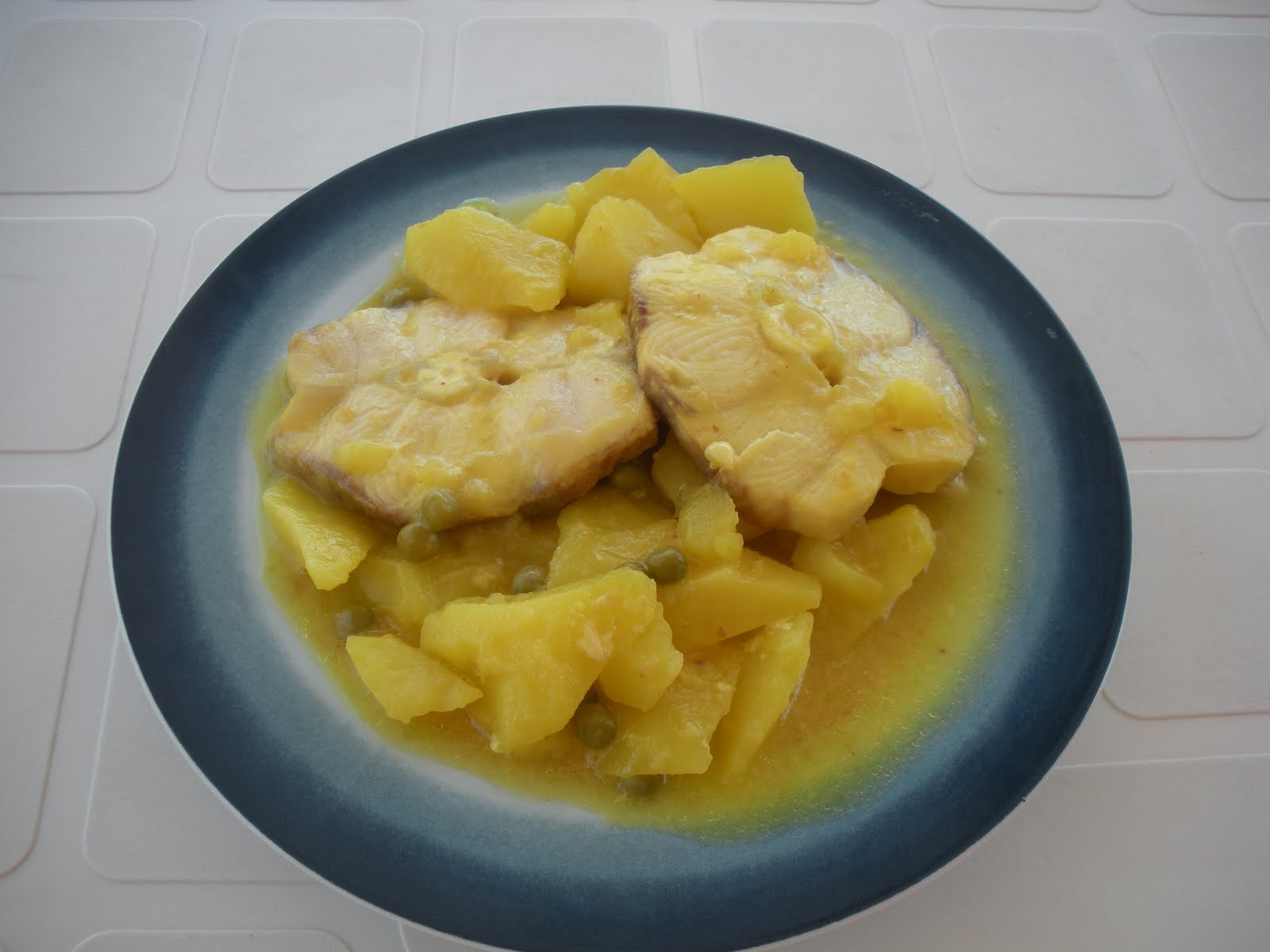
Andalusian Recipes 1. Dogfish with potatoes or in Spanish: Cazón con patatas


Dogfish with potatoes
One of the easy to made and delicious recipes of Andalusia is Dogfish with potatoes.
The dogfish is normally sold in slices and if you buy half a kilo, have some onions, potatoes, garlic and saffron or colouring powder, you are ready to make this special recipe for 4 people.

Dogfish, Hondshaai, Katzenhai, Chien de Mer
You bake the onion cut in slices in olive oil, half a cup
You cut the potatoes in small chops or in slices and add them to the onions when turning gold.
You bake the potatoes and add some garlic for some 15 minutes, turning and turning around.
You add some water and white wine or sherry (just covering the potatoes) and put the slices of dogfish on top.
Let this cook during 5 minutes, turn around the dogfish (careful) and let it cook for some other 5 minutes.
And: dish ready to be served!
 
Watch the video if you want more instructions and learn some more spanish.


Friday, 5 October 2012

New album Estrella Morente

Flamenco singer Estrella Morente has released a new disc 'Autorretrato' on October 2nd which she inicially started to make with her father Enrique Morente, passed away in december 2010.


The album began to take shape several years ago, when Estrella Morente met up with Michael Nyman in London: “There was a piece that was thirty years old: 'Réquiem'. I go to a book by San Juan de la Cruz and I find the most wonderful poem you could ever read. It fit in perfectly. It was a live musical encounter”. Enrique Morente was the one who linked it to the pregón by Niño de las Moras: “He fell in love with that pregón and we sent it to Michael for him to orchestrate it. It’s the song that opens the disc. It hasn’t been played again”, she says. At the same time as songs started to arise, Estrella Morente began to compose the album’s lyrics and music. “My father boosted my personality, he guided me anew. He didn’t hold back my expression. And that artistic sentiment led me to the self-portrait”, she admits.

Estrella y Enrique Morente

The cantaora defines as “the reflection of an interior” this fourth studio album in her career, which breaks a silent spell of six years without a record, since she released 'Mujeres' in 2006. The repertoire consists of fifteen songs, over and hour of music, which combine roots and innovation. Seguiriyas, pregones, bulerías, old-time sevillanas and pregones, are combined with poems by San Juan de la Cruz, a tribute to Lola Flores, an habanera by Carlos Cano, Caribbean rhythms and a requiem. Musicians such as Paco de Lucía, Vicente Amigo, Tomatito, Antonio, Josemi and Juan Carmona, Pat Metheny and Michael Nyman, among many others, take part on the album, whose directing was concluded by Isidro Sanlúcar following Enrique Morente’s death.

Information from Flamenco World

Saturday, 29 September 2012

Tuesday, 4 September 2012

Exhibition Sorolla, spanish impressionist painter in Alhambra

Valencian artist Joaquín Sorolla (1863-1923) has returned to the Alhambra this summer with his Gardens of Light, a travelling exhibition that will have three different settings: the Palazzo dei Diamanti, seat of the Gallerie d’Arte Moderna e Contemporanea di Ferrara (Italy), the Palace of Carlos V Museum of Fine Arts, in Granada, and Madrid’s Sorolla Museum.


The exhibition, commissioned by a committee of experts made up of Tomás Llorens, Blanca Pons-Sorolla, María López Fernández and Boye Llorens, aims to show Sorolla’s fascination with gardens, fortified after his trip to Andalusia and, particularly, his experiences in the Alhambra, and the impression caused on him by the Sierra Nevada with its white blanket of snow.

The exhibition retraces the encounter between Joaquín Sorolla and Andalusia – its millenarian culture, the landscapes of the Sierra Nevada, the Arab courtyards and gardens of the Alhambra, and the Alcazar of Seville all providing inspiration and material in the form of clear, lyrical visions. In these compositions, human presence is banished and flora, marble, tiles, light and colours all come to life. The artist’s brush conveys reflections on water, light filtering through and dissolving geometrical architecture, and the colourful mosaic of the southern garden.

Sorolla. Gardens of Light is broken down into five sections (Earth, Water, Courtyards, Gardens, and the Garden of the Sorolla House), all contributing, without a doubt, to a better understanding of the work of the Valencian painter, who continued to reflect on the possibilities of his art until the very end of his life. The exhibition focuses on a crucial moment in the creative life of the painter, the years of his full maturity and, specifically, the works arising from his fascination with gardens and his meeting with Andalusia, which affected him so deeply as to make him remodel the poesy and style of his work in his later years.

Hall of Ambassadors, Alhambra


After his visit to the Alhambra in 1909, Sorolla painted vistas of the Alhambra and Generalife time and time again, including Torre de los Siete Picos, the Court of the Myrtles, the Lindaraja Mirador, the Comares Court and the Garden of Daraxa, this last dated to 1917.

In Andalusia, Sorolla, considered one of the most fascinating figures of the Spanish art world of the 19th and 20th centuries, discovered a subdued richness, a source of poetry, contained in shady corners, the murmur of water in the fountains and in the silence of sun-bathed courtyards. His own garden, planned and laid out at that time, further transmitted and amplified his metamorphosis.

Location: Palace of Carlos V. The Alhambra and Generalife site
Dates: till 14 October 2012
Hours: Daily: 10 am - 8 pm

Free admission

Text from: Patronato del Alhambra